Why Community Matters in Trauma Healing and Why an Offline Space Can Make a Difference

When it comes to community, it is important to be able to transcend always being in physical locations, especially since having babies, and its important to also balance both so there are specific places I like to frequent like my friends small business farms and community store co-ops as the community I live in reflects the right to farm and is rich is recreational activities like hiking, white water rafting. The trust we build as consumers and producers, regardless of our different backgrounds and stories, helps us enhance the community economically and creates more opportunities for growth and enrichment. For example, we live in a rural community, and due to a lack of funding to keep the elementary school open, it was forced to close. To offset the loss, the community came together to redevelop the school into a center for cooking, hosting events, and housing the town's municipal staff.
I feel most welcome in communities that provide opportunities. During COVID-19, we all felt the effects of having to transition online, so since then, in 2021, I have worked to create interpersonal connections online. Creating a space for women to heal outside of social media required reinventing how we use social media in healthier ways and educating others about taking breaks from hours of scrolling and from feeling overwhelmed. The poem from this week's resources song to myself helps describe the feeling of being within my online group of women, "I am satisfied—I see, dance, laugh, "sing;" (1892)
College experience, especially here at Walden, has brought a new sense of community in education. I felt supported by peers and, most importantly, our teachers. The best part was building a strong community through discussions and, most recently, a peer assignment in which we combined schedules and experience to work through a difficult task. I have always viewed myself as empathetic and kind. So it was refreshing to share my values with others. The experience with college has most definitely felt welcoming. When it comes to my overall college experience, I feel it has definitely influenced my progress and identity, helping me become more disciplined and better able to work well with others while expanding my knowledge of psychology and other classes that will support my overall goal of helping others transcend trauma. As noted by Dr. King, by knowing our blueprint through our deepest and sometimes most painful experiences, we can be reshaped toward dignity and become a source of grace, love, and empathy to help others navigate the complexities of life and the world. So you never doubt your merit or truth in transcending trauma and advocating for thriving, not just surviving.
Whitman, W. (1892). Song of myself. Poetry Foundation. https://www.poetryfoundation.org/poems/45477/song-of-myself-1892-version
King, M. L., Jr. (1967, October 26). What is life's blueprint?The Seattle Times.https://projects.seattletimes.com/mlk/words-blueprint.html
This was my recent Essay at Walden University currently graduating 8-16-26
Community can be one of the most powerful factors in trauma recovery. While healing is deeply personal, it doesn't have to happen in isolation. For many women, a supportive community offers a space to feel seen, understood, and accepted without judgment. That sense of belonging can help reduce shame, increase resilience, and reinforce healthy coping strategies.
Offline communities often provide additional benefits because they reduce the pressures that can come with social media and online comparison. They encourage intentional participation, privacy, and deeper engagement with the healing process.
Healing from trauma isn't simply about moving on from the past. It's about rebuilding trust, discovering safety within yourself, and reconnecting with others in ways that feel authentic and supportive.
For many women, one of the greatest barriers to healing is the belief that they must carry everything alone. Trauma often creates isolation. Community helps gently interrupt that isolation by reminding us that we don't have to navigate healing without support.
Healing Happens in Connection
Trauma can leave us feeling disconnected—from ourselves, our bodies, and the people around us. A compassionate community offers opportunities to:
Feel understood by others who share your experiences.
Practice vulnerability in a supportive environment.
Celebrate progress, no matter how small.
Learn new perspectives and coping strategies.
Remember that healing is not linear.
While each person's journey is unique, being witnessed with empathy can be deeply meaningful.
Why an Offline Community Can Feel Different
Social media has made it easier than ever to connect, but it also comes with distractions and pressures that may not support healing.
An offline membership or private community can offer:
Greater privacy. Members choose to engage in a dedicated space rather than on a public platform.
Fewer distractions. Without endless scrolling, advertisements, and notifications, it's easier to stay present.
More intentional participation. Members arrive because they want to focus on personal growth, not simply consume content.
A calmer environment. Healing benefits from spaces that encourage reflection instead of comparison.
Ownership and continuity. Independent communities aren't subject to changing social media algorithms that determine who sees your content.
Quality Over Quantity
Healing communities don't need thousands of members to create meaningful impact.
A smaller, engaged group often provides:
deeper conversations
consistent encouragement
genuine relationships
mutual accountability
psychological safety
When people feel respected and supported, they're often more willing to participate at their own pace.
A Space to Grow
The most effective healing communities recognize that everyone moves through recovery differently. Rather than expecting constant participation, they provide resources that members can return to when they're ready.
These might include:
guided meditations
educational workshops
reflective journaling prompts
live discussions
opportunities for quiet reflection
optional community conversations
This flexibility allows members to engage in ways that feel supportive without pressure.
Healing Doesn't Mean Walking Alone
There is strength in finding your own voice, and there is also strength in knowing others are walking alongside you.
An intentional community offers more than information. It provides connection, encouragement, and a reminder that healing can be supported through compassionate relationships.
Whether someone is just beginning their journey or continuing years of personal growth, a thoughtful community can become a place where they feel seen, supported, and empowered to move forward—one step at a time.
Let’s dive deeper…
If your goal is to create a sustainable, trauma-informed membership that fosters real transformation rather than simply delivering content, your own website is typically the strongest long-term investment. Since you've already built your brand around your own website, I think you're on a solid path.
Why your own website wins
Personally, I LOVE being a Silver Circle member here at SquareSpace since 2020
Having your membership on your website means:
You own your customer list.
You aren't dependent on another company's algorithm or policy changes.
Members associate the experience with your brand—not someone else's.
Everything can live in one place:
coaching
workshops
meditations
downloadable workbooks
blog
podcast
shop
community
booking calendar
It creates a seamless experience for members.
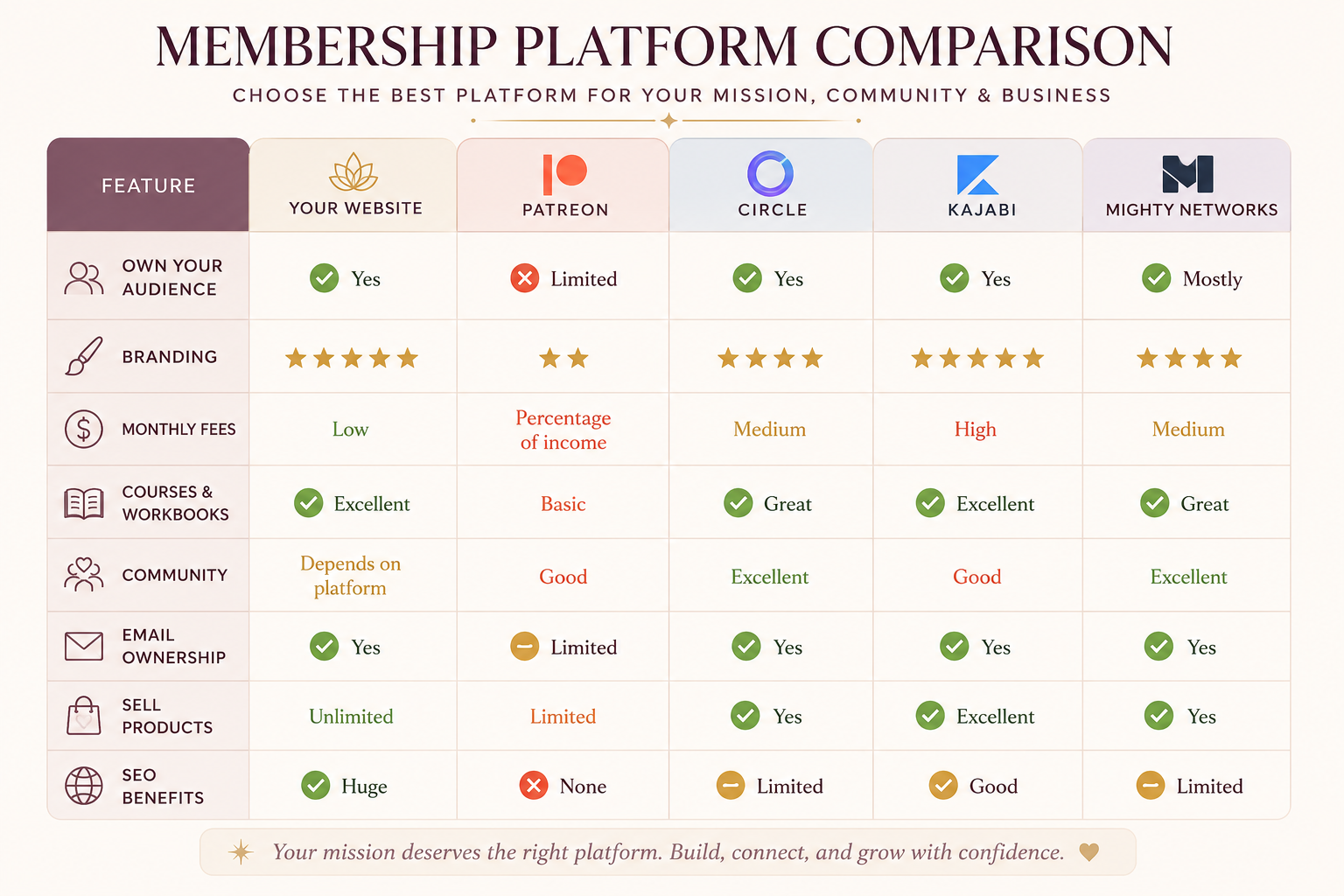
Patreon: Great for creators
not ideal for healing communities
Patreon is excellent if you're primarily creating:
podcasts
art
music
behind-the-scenes content
videos
Less ideal for:
structured healing journeys
educational programs
certifications
printable workbooks
coaching pathways
Many members also view Patreon as a place to "support a creator" rather than participate in a transformational program.
Circle
Circle is one of the best community platforms available.
Great for:
discussion groups
live events
courses
member directories
accountability
challenges
It works well if your community is the centerpiece of your offering.
Kajabi
Kajabi is like an all-in-one business operating system.
It includes:
website
courses
email marketing
funnels
memberships
coaching
automations
payments
Pros:
Beautiful user experience
Powerful marketing tools
Excellent automation
Cons:
One of the most expensive options
More features than many creators need when starting out
Mighty Networks
Excellent if your focus is on building a social community.
Members can:
chat
post updates
join groups
attend live events
complete courses
It feels more like a private social network than a learning platform.
Tips for creating a healthy membership
The biggest reason people cancel memberships isn't price—it's feeling disconnected or overwhelmed. A healthy membership emphasizes steady progress over constant content.
Some practices that help:
Focus on one theme each month.
Offer a mix of learning and reflection rather than endless downloads.
Keep new content predictable.
Encourage members to move at their own pace.
Celebrate small wins and participation.
Build opportunities for connection, not just consumption.
Archive content in an organized library so members can easily revisit it.
Regularly ask for feedback and adapt based on what members actually use.
A simple monthly rhythm
Week 1: Introduce the monthly theme and release the workbook.
Week 2: Share a workshop or teaching session.
Week 3: Release a guided meditation or integration practice.
Week 4: Host a live Q&A, reflection circle, or community gathering.
Learn More below
The Seastar Sisterhood offers a growing library of healing resources created from my 8 years of training, lived experience, holistic healing practices, coaching knowledge, and continued education. Members receive monthly workshops, workbooks, guided meditations, Reiki-infused practices, spiritual teachings, reflection tools, community connection, and exclusive resources. The combined value of these offerings is over $500+ annually Save $50 on a yearly membership and get entered into giveaways